Monday, April 27, 2020
Friday, April 17, 2020
Digital Student Teaching Week #4
Strengthening Communication
During Remote Learning Week #4, my student teacher Miss McDaniel @miss_tmcdaniel and I explored different ways to strengthen our communication. As teachers we need to differentiate our communication based-on the different family circumstances. Some parents are working in the medical field or different emergency capacities. We need to find a way to help these families so students can be more independent online as parents work long hours. We provide a one-stop schedule with the different embedded hyperlinks in a Google Template every week. We organize our schedule in the Schoology Calendar. At the beginning of every week, we provide a recording with an overview of the different assignments. Also, we provide two options for directions. We provide a visual description, and we provide a recording that we create using Screencastify. I love using the grading features that Schoology has in place on the ipad. I am able to write on the students documents to provide direct feedback. We do not want to ask students to complete assignments without providing feedback. We are continuing to recognize the work of our students. We give shout-outs through the week on Schoology, and we recognize students during our weekly Google Meets. If you have additional ideas about how we can further strengthen communication then please reach out to us. If you have questions about different tools that we are using then please connect with us too. We are stronger to together. Our purpose for sharing our vlog is share our story in case it helps others.
Thursday, April 9, 2020
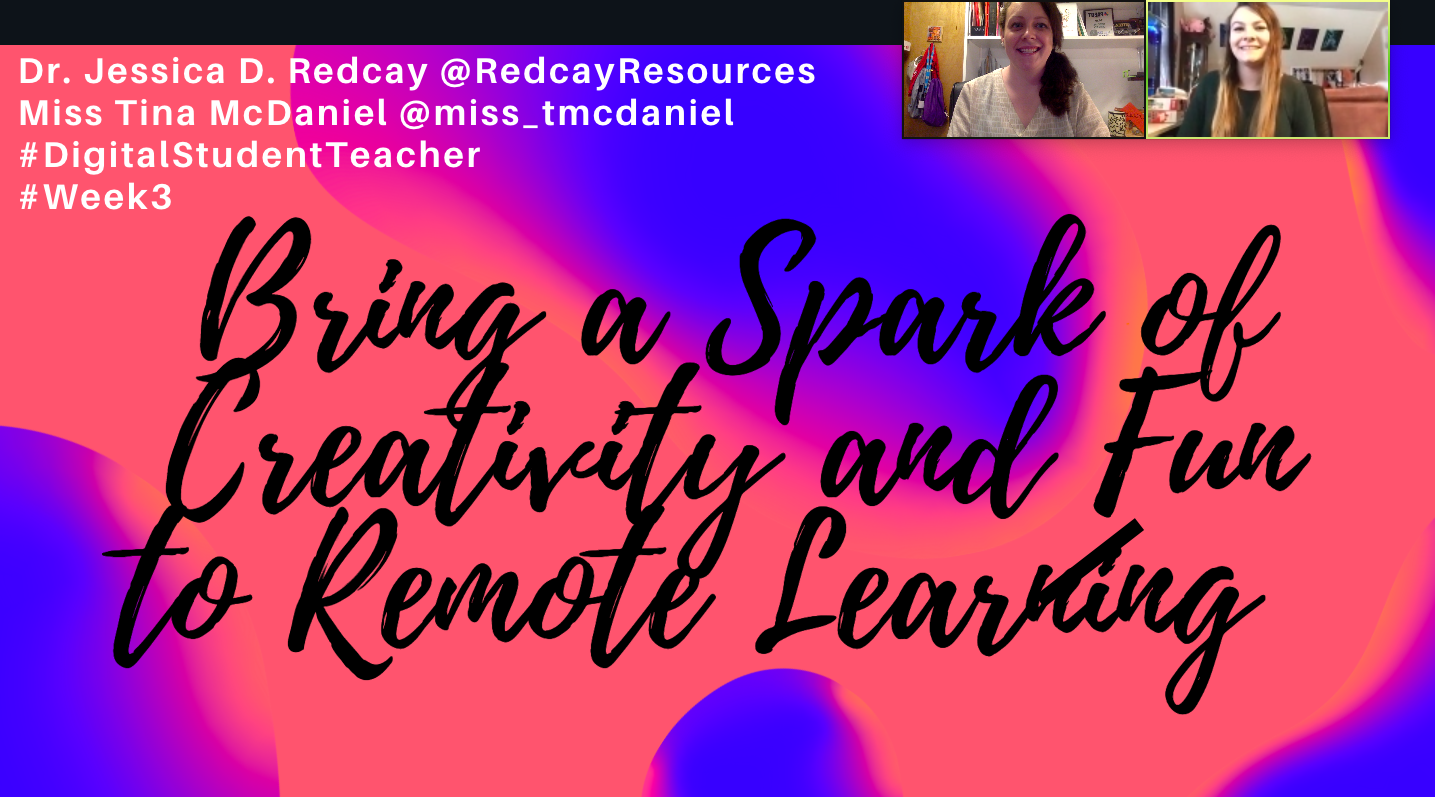
Bring a Spark of Creativity and Fun to Remote Learning
Check-out Our Vlog: https://youtu.be/uuSsPgczGbg
My student teacher and I shared our digital student teaching vlog #3. This is a vlog that will help all teachers who are looking for ways to bring a spark of creativity and fun to remote learning. We know that these are tough times so we wanted to share some of the things that we found that engage our students. Specifically, we focused-on how to use digital breakouts, VR writing prompts, and Flip-hunts. Please reach out to us if we can support in any ways. We are all in this together.
Friday, April 3, 2020
Digital Student Teaching Week #2
Customizing and Adapting
Click here to watch our Vlog Post #2: https://youtu.be/TtC9_Fm39hg
We have completed one week of remote learning. My student teacher and I shared in our Vlog Post about the lessons that we learned. We found that everything we learned fits under the umbrella of customizing and adapting our instruction.
This week we spent a lot of time working with different families to help them get logged-in to everything at home. We decided to keep things simple. We did not introduce new tech tools this week. Rather, we used the tech tools that the students were already familiar with using in the classroom. Also, we staggered different activities each day. We created video tutorials to walk families through different issues. Overall, we thought things went smoothly.
We remained flexible, and we made it our purpose to connect and listen to the feedback from students and families. We tried a shared Google Sheet to have the students describe their feelings, but it worked differently remotely. In the classroom, the students go the slide that matches their student number. However, remotely it didn't work out yet. So we transitioned over to a Google Survey. It was awesome!
The highlight of the week came from our collaborative planning time. If we saw individual feedback that we needed to address then we could reach out to those families individually. Next we analyzed the overall feedback of the class to gauge how everyone was feeling. When we used the feedback to customize our instruction then it felt like a sigh of relief. It seemed like everyone felt more comfortable and connected.
We spent a lot of time making daily videos, but when we tracked the analytics then we realized that the majority of the class was not using these materials. We took a poll in Schoology, and we realized the families were looking for live interactions. We connected with our students using a Google Meet, and it was a success.
Also, we have been interacting and watching the different FlipGrid posts of the students. We noticed that the kids in this class loved making blanket forts. We decided to create our own class blanket fort competition. The kids will design a blanket fort, and they will share it with the class using FlipGrid. At the beginning of the week, I didn't imagine us having a blanket fort competition, but it is important to tap into the interest of the students.
This week we focused on adapting and customizing online instruction based-on the feedback of the students and families.
Saturday, March 28, 2020
Digital Student Teaching Week #1
Relationships
Podcast Digital Student Teaching Week #1 Developing Relationships Virtually:
Miss Tina McDaniel is my student teacher this year. She has a dual placement so she started with me as soon as we transitioned to remote learning. We decided to share our journey with weekly podcasts. We would like to share our story because we know that other people are also experiencing digital student teaching for the first time too.
One thing we shared in our podcast was how important it is to establish strong relationships with families and students through distance learning. Miss McDaniel created a video to introduce herself to the class. She had the students respond to her through FlipGrid.
Throughout this transition, our goal was to develop a framework to foster a strong classroom culture. We wanted to find a way to make students and families feel safe, connected, and supported. We decided to provide Morning Chats to the families. During our Morning Chats we explain to the students and families how things will work for the day. Also, we are able to provide the students with a shout-out every day. We were able to see who might be struggling so we can connect and support every family. We are hopeful that we can increase the motivation of our student when they can receive a morning shot-out. When we recognize our students then we are letting the students that we see them, and we are acknowledge their hard work.
Miss McDaniel explained that you just need to be cooperative and flexible through this new process. There are a lot of things changing right now. This is a learning experience for everyone. Embrace this experience! We are able to collaborate and stick together through these challenging times.
We teach students. Even though we might not be physically together, we need to find ways to make it work. Be real with your students, and share your own mistakes with your students.
Monday, January 20, 2020
Lessons From Snap Podcast
Lesson Learned From a
Podcast With Evan Spiegel and Jon Gordon
Here is the link for the full podcast: https://positiveuniversity.com/episode/evan-spiegel/
When I was a teenager, I decided that I wanted to be a teacher. My older brother decided that he wanted to be an entrepreneur. My brother drove me to the bookstore, and he walked me to the education section of the store. He told me that if I want to be an educator then I need to read everything that already exists within my field. I sat in the store reading books, and my brother went to the section of the store that was of interest to him. When you fast forward in life, I still continue to read everything that I can about education. As I prepare to teach a new course this semester, I read 40 books. Plus, I still have a lot of books on my list that I want to read. My brother started his own company, and he continues to stay knowledgeable about what is going on within his field.
In addition, I love listening to podcasts as I work-out. I loved listening to the Podcast between Evan Spiegel and Jon Gordon. I love learning about the story behind the journey of different inventors, entrepreneurs, educators, etc. I found a lot of parallels between what was shared from the creator of Snapchat (now called Snap), and lessons that I can learn as educator.
I love that Evan Spiegel explained that he started his journey with being an entrepreneur from a college course. The professor had different guest speakers. He was able to see different possibilities by learning from these experiences. I love that as educators we can open doors, and we can provide students with possibilities that can help them find their true direction or purpose.
Before Snap, Evan Spiegel had invested a year working on a project called "Future Freshman." The project wasn't working, and it was difficult for him to let go of it to change to something that did work. However, by letting go of the things that didn't work he was able to move into something better. Also, he could not focus on what others were doing around him. He had to stay on track working with his friend to try new things. I remember that when I was 100 pages into my dissertation, I found out that my dissertation committee didn't like it. It was difficult, but I threw the dissertation away, and I started again. It worked, and I was able to create a new curriculum: Ludus Reading. Evan Spiegel said, "Start with an idea that is simple, so you can learn as quickly as possible." We need to teach our students that we learn from our failures. Our failures can lead to opportunities that we never imagined. "We need to take big risks as long as we believe in it." The idea to fail forward is a new concept that I have introduced to my Girls Who Code Robots Club. Their first assignment was to fail as much as possible. The girls were shocked, but it allowed them to take creative risks, and they could move away from worrying about failing. We need to learn from our mistakes.
One thing that Snap does well is that they listen to the community. They make changes to their company based-on the feedback from the community. However, they are strategic in how they respond to the requests of the community. In our classroom, we need to listen and get to know the learners who are part of our community. We need to find ways to change our instruction to best meet the needs of our students. However, we need to be intentional about the instruction that we provide to the students based-on their feedback.
When you are building a start-up then you need to focus on positivity. You receive a lot of negativity from the public versus when you work as a private company. We had to be ten times as positive within our company to overcome the negativity that comes from the outside world. Positivity is magnetic and it attracts great people! In our classroom we have some students who come into our classroom who have experienced a great deal of negativity in their life. We are lucky as teachers because we get to invest in our students. Sometimes we are the only bright spot in that students' life. We need to remember to shelter our students from negativity. We need to let them know they are valued.
We have so much to learn from one another. Snap uses council, which is a concept that he learned when he was in school. There are three rules: Speak from the heart. Listen from the heart. Be spontaneous. Everyone sits in a circle, and everyone listens to one another. In our classroom, we have a morning meeting every day where the students have to learn how to be active listeners. It is important for young learners to be able to take the perspective of others. We can achieve a lot when we can understand that we area valued, and we are in a safe place to share our ideas.
I think we could add a little extra Snap to our classroom instruction. We can bring in experts to share things with our students. We can create a positive culture where students actively listen to one another. We can listen to our students to help improve our classroom culture. Students need to remember to continue to fail forward. There are a lot of other takeaways from this podcast, and I would highlight recommend it.
Saturday, December 7, 2019
My Visit to RoboKind
I had incredible time visiting RoboKind in Dallas, Texas. The best way to describe the experience is by using an analogy. The experience made me feel like Charlie Bucket in Roald Dahl's "Charlie and the Chocolate Factory." I always wanted to have the opportunity to learn more about how RoboKind created my favorite humanoid robot, Robon, who I code as a teaching assistant in my classroom. When Charlie's dream came true, and he enters the chocolate factory he sees things that were created beyond his wildest dreams, and he saw a lot of chocolate too. We did have chocolate because I brought it from Hershey, PA (my home state). However, the main point was that I saw things that stretched my current thinking about how all students can gain equal access to education now and in the future. Roald Dahl's book was fiction, but the things that I saw were real!
The other thing that changed my perspective is learning more about the behind the scenes of developing transformative educational technology tools. In Roald Dahl's book you visualize these amazing creations, but it is rare that you think about everything that went into the development process. One of my favorite parts of the visit involved learning more about the different versions of the humanoids. There are so many different intricate details that go into the process of taking an idea to create a humanoid robot and actually being able to see the vision transform into a physical creation. When I shared my observations with my 9 year old daughter, she said, "It makes sense why Richard Margolin persevered in the process of creating Robon. He did it because it mattered." She is correct. The humanoids from RoboKinds are making a positive impact for my students and students around the world. These humanoids are being used to help develop social skills with students who have Autism. Further, there is a curriculum used to teach students how to use visual block coding. The students are able to use their code to work with an avatar, but then the code can be connected to the physical humanoid robot too. This is a versatile platform that can be used in so many different ways.
I always respect EdTech companies that value the opinions of the teachers and students who are using these resources. We need to continue to have teachers and engineers partnering together to help create meaningful instructional experiences for our students. I learned a lot from talking to the engineers and everyone who works at RoboKind. I have left this experience with a lot of ideas! I am looking forward to finding ways to best help students learn more about the newest form of literacy: coding. I want students to realize the value in being able to transform their thoughts into a physical creations. I want students to realize that it is ok to fail forward, but it is important to always continue to work hard throughout the design process because it matters!
Subscribe to:
Posts (Atom)